
The Transformational Mindset That Builds Lasting Wealth, Why Earning More Money Doesn’t Always Make You Rich.

The Transformational Mindset That Builds Lasting Wealth, Why Earning More Money Doesn’t Always Make You Rich. Home Many people equate a higher income with wealth. They chase bigger salaries, hoping it will solve their financial problems. Yet, often, higher earnings lead to higher spending. Consequently, income increases, but real wealth does not. The truth is, wealth comes from mindset as much as money. People with a transformational mindset understand this principle. They focus on building lasting financial stability instead of temporary income gains. This content explores the mindset that creates long-term wealth and explains why simply earning more isn’t enough. Understanding Wealth Beyond Income Income alone rarely builds wealth. Most people spend what they earn. High salaries can disappear quickly when spending habits are unchecked. Meanwhile, modest earners can build wealth if they use money strategically. Wealth grows when people manage resources intentionally. It increases with investments, assets, and compounding growth. A transformational mindset helps individuals make choices that maximize these factors. Hence, wealth is not just a number in a bank account. It’s the result of disciplined thinking and deliberate action. The Difference Between Earning and Building Wealth Earning more money feels satisfying. However, wealth requires more than income. Income is temporary. Wealth is lasting. People who earn without saving or investing often experience financial stress. They remain vulnerable to emergencies, debt, and inflation. On the other hand, people who build assets generate long-term financial security. Assets produce income independently of work. For example, rental properties, investments, and businesses create cash flow. The transformational mindset focuses on asset-building rather than only earning. How the Transformational Mindset Works A transformational mindset shifts focus from short-term gain to long-term growth. It emphasizes planning, patience, and discipline. People with this mindset: Prioritize assets over expenses. Seek multiple income streams. Make deliberate financial decisions. Embrace long-term strategies like investing and compounding. Instead of reacting emotionally to money, they think strategically. Consequently, they avoid common financial pitfalls, such as lifestyle inflation or impulsive spending. Common Pitfalls of Relying on Income Alone Relying solely on income creates financial fragility. Paychecks can disappear suddenly due to layoffs, business closures, or health emergencies. Moreover, higher income often triggers lifestyle inflation. People upgrade homes, cars, and habits, consuming extra money immediately. As a result, they earn more but save less. Debt may also accumulate when spending exceeds income. In contrast, wealth-focused individuals redirect extra earnings toward investments and assets. This approach compounds growth and secures long-term financial independence. The Role of Financial Literacy Wealth grows faster when financial literacy guides decisions. Financial literacy includes understanding: Asset management Debt management Investing strategies Budgeting and cash flow People lacking financial knowledge often struggle despite high earnings. Meanwhile, financially literate individuals maximize the impact of their money. They know how to use income to build wealth rather than simply consume it. Therefore, knowledge becomes the foundation of a transformational mindset. Related Contents Load More The Power of Asset-Building Assets form the backbone of lasting wealth. Unlike income, assets generate money even when people are not working. Examples include: Stocks and bonds Real estate investments Business ownership Intellectual property Investing in assets requires patience and discipline. It also requires avoiding unnecessary liabilities, such as high-interest debt or depreciating items. When assets multiply, financial freedom becomes achievable. The transformational mindset understands this clearly. It prioritizes long-term growth over short-term gratification. Understanding Lifestyle Inflation Lifestyle inflation occurs when spending rises with income. People may increase their lifestyle when they earn more, buying luxury items, expensive cars, or bigger homes. Although these upgrades feel rewarding, they rarely increase net worth. Instead, wealth can stagnate or decline. The transformational mindset resists unnecessary inflation. It channels extra earnings into assets, savings, and investments. Over time, small, disciplined actions lead to significant wealth. Multiple Streams of Income Relying on a single income source is risky. Life can disrupt employment unexpectedly. Therefore, wealth builders diversify income streams. These streams may include: Side businesses Freelancing Dividend income Real estate rentals Diversification reduces financial risk and increases wealth-building potential. The transformational mindset identifies and develops these streams systematically. Delayed Gratification and Patience Wealth rarely grows overnight. Delayed gratification plays a central role in the transformational mindset. People resist impulsive spending. They save consistently and invest strategically. They prioritize long-term gains over short-term pleasure. This patience compounds results exponentially. Eventually, disciplined individuals enjoy financial freedom without dependence on high income alone. Strategic Planning for Long-Term Wealth Planning transforms income into wealth. Strategic financial planning includes: Setting clear financial goals Allocating money toward assets Managing expenses responsibly Monitoring progress regularly A transformational mindset treats money as a tool rather than a reward. It emphasizes control, purpose, and direction. As a result, wealth grows predictably instead of relying on luck or temporary earnings. The Psychology of Money and Mindset Behavior shapes financial results more than numbers alone. People with a transformational mindset adopt empowering financial beliefs. They view money as a resource, not a status symbol. They embrace learning, patience, and calculated risk. Consequently, they make decisions that generate long-term value. Mindset drives action. Action creates wealth. Without the right mindset, even high earners often struggle to achieve lasting financial success. Practical Steps to Adopt the Transformational Mindset Adopting this mindset requires deliberate action. Start with the following steps: Track income and expenses meticulously. Identify opportunities for asset building. Avoid unnecessary debt and liabilities. Develop multiple income streams. Prioritize long-term growth over instant gratification. Educate yourself consistently about investing and financial strategy. These habits gradually transform thinking and behavior. Eventually, they establish a foundation for wealth that lasts a lifetime. Why Earning More Money Alone Isn’t Enough High earnings are only one component of financial success. Without a transformational mindset, income often disappears into spending. Wealth depends on how money is managed, invested, and multiplied. People who earn more without planning may still struggle financially. Conversely, those who focus on strategy, assets, and long-term growth often achieve financial independence regardless of income level. The mindset becomes the defining factor between temporary income and
Common Financial Terms People Pretend to Understand — The Breakthrough Guide to Mastering the Language of Money.
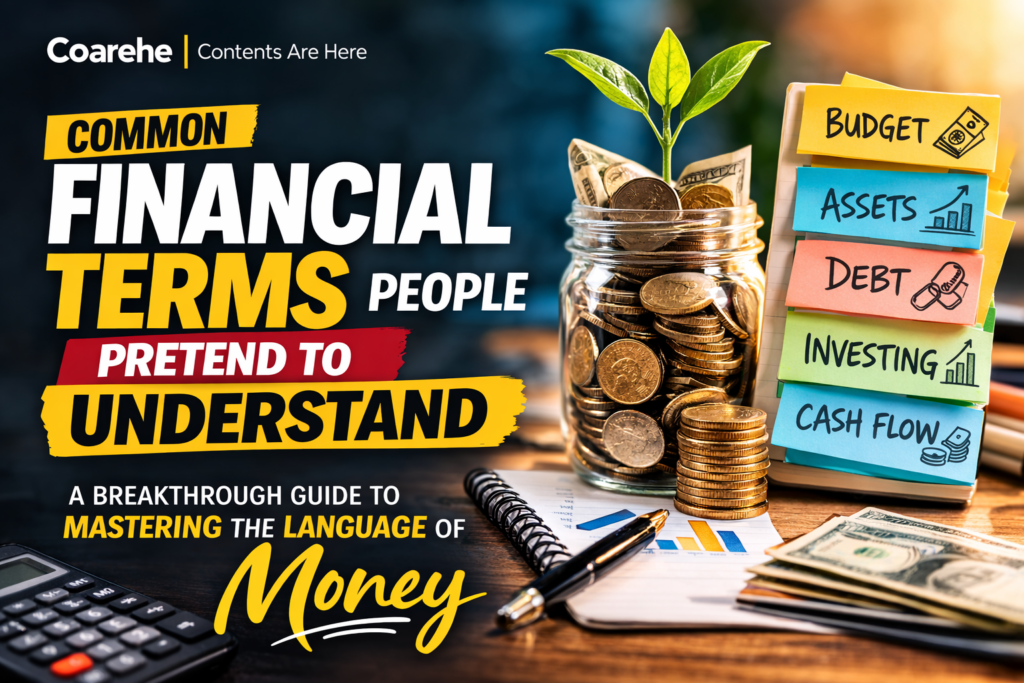
Common Financial Terms People Pretend to Understand — The Breakthrough Guide to Mastering the Language of Money. Home Money conversations often sound complicated. People throw around words like assets, equity, and cash flow with confidence. Yet many people secretly feel confused. They nod during conversations while hoping no one asks them to explain the terms. However, this confusion does not mean someone lacks intelligence. In reality, it shows a gap in financial education. Schools rarely teach the real language of money. Therefore, most people learn financial terms through experience, mistakes, and observation. Nevertheless, understanding these terms changes everything. Once you master them, financial decisions become clearer, smarter, and more strategic. In this content, you will learn the common financial terms people pretend to understand. More importantly, you will learn how these terms shape wealth, security, and financial freedom. Why Understanding Common Financial Terms Matters Many people focus only on earning money. However, earning alone rarely creates wealth. Financial language shapes financial thinking. Therefore, when people misunderstand financial terms, they often make poor money decisions. For example, someone may chase a high salary. Yet that person may ignore investments, assets, or long-term growth. As a result, income rises while wealth stays stagnant. On the other hand, financially literate people use money more strategically. They understand how financial concepts work together. Consequently, they build wealth faster. In other words, learning common financial terms does more than improve knowledge. It improves your financial future. Asset: The Wealth Builder Most People Misunderstand The word asset appears everywhere in finance conversations. However, many people misunderstand its true meaning. An asset is something that puts money into your pocket. It creates income, growth, or financial value over time. For instance, investments, businesses, rental properties, and stocks qualify as assets. However, people often label expensive items as assets when they actually lose value. Luxury cars, expensive gadgets, and designer items may feel valuable. Yet they usually decrease in value after purchase. Therefore, they rarely qualify as wealth-building assets. True wealth builders focus on acquiring income-producing assets. Over time, these assets generate cash flow and long-term growth. Consequently, the path to financial independence becomes clearer. Liability: The Silent Wealth Destroyer While assets build wealth, liabilities slowly drain it. A liability is something that takes money from your pocket. It creates expenses instead of income. Loans, credit card debt, relationships and car payments fall into this category. However, many people overlook how liabilities affect their finances. They focus on lifestyle instead of long-term impact. As a result, liabilities accumulate quietly. Monthly payments grow larger. Financial stress grows heavier. Eventually, income struggles to keep up. Therefore, financially smart people control liabilities carefully. They reduce unnecessary debt and prioritize financial flexibility. In the long run, this discipline protects wealth. Cash Flow: The Lifeblood of Financial Stability Many people believe wealth comes from high income. However, cash flow matters far more. Cash flow simply means the movement of money in and out of your life. Positive cash flow occurs when income exceeds expenses. Negative cash flow happens when spending exceeds earnings. Although the concept seems simple, many people ignore it. High earners sometimes live paycheck to paycheck. Meanwhile, moderate earners may build strong financial stability. The difference lies in cash flow management. When people control spending and increase income sources, they create positive cash flow. Consequently, they gain financial breathing room. Eventually, they gain the ability to invest and build wealth. Net Worth: The True Measure of Financial Health Many people judge wealth based on visible income. However, income alone rarely reflects true financial strength. Instead, net worth tells the real story. Net worth equals assets minus liabilities. This number reveals what someone actually owns after debts disappear. For example, a person earning a high salary may still carry heavy debt. In that case, net worth may remain low. Meanwhile, someone with modest income may own assets and carry little debt. Consequently, that person may enjoy higher net worth. Therefore, financially aware individuals track their net worth regularly. Over time, they aim to increase assets while reducing liabilities. As a result, their financial foundation becomes stronger each year. Inflation: The Invisible Force That Eats Your Money Inflation rarely appears in daily conversations. However, it quietly shapes the value of money. Inflation refers to the gradual increase in prices over time. As prices rise, purchasing power falls. In simple terms, money buys less in the future. For example, groceries, housing, and transportation usually cost more each year. Therefore, money sitting idle loses value over time. This reality explains why investing matters. Investments aim to grow money faster than inflation reduces its value. Consequently, financially informed people focus on growth strategies instead of simple saving. Related Contents Load More Diversification: The Smart Risk Strategy Financial markets rarely move in predictable patterns. Some investments rise quickly. Others fall suddenly. Therefore, smart investors rarely place all their money in one place. Instead, they practice diversification. Diversification spreads investments across different assets, industries, or markets. For example, an investor may combine stocks, bonds, real estate, and businesses. As a result, losses in one area may balance gains in another. This strategy reduces risk while protecting long-term growth. Consequently, diversification remains one of the most powerful wealth strategies. Equity: The Ownership Advantage Many people hear the word equity yet hesitate to define it. In simple terms, equity represents ownership value. For example, homeowners gain equity when property value increases or when they repay mortgage debt. Similarly, business owners hold equity in their companies. Equity matters because it represents wealth ownership rather than temporary income. Over time, equity can grow significantly. Consequently, people who prioritize equity often build stronger financial foundations. Interest: The Double-Edged Financial Tool Interest plays a powerful role in finance. However, it works in two opposite directions. First, interest can grow money. Savings accounts, bonds, and investments often generate interest income. Over time, compounding interest can dramatically increase wealth. However, interest can also drain money. Credit cards, loans, and debt obligations charge interest payments. Consequently,
How Financial Technology Is Reshaping Our Lives and Unlocking a Smarter, Fairer Future
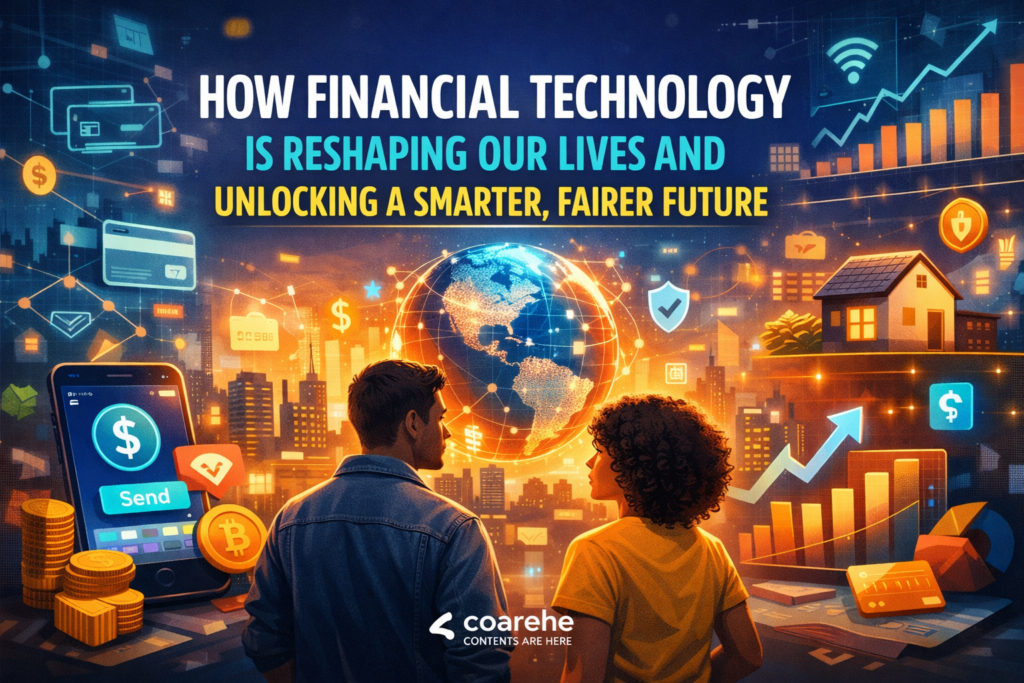
How Financial Technology Is Reshaping Our Lives and Unlocking a Smarter, Fairer Future Home Financial technology—better known as fintech—has moved far beyond buzzword status. Today, it actively shapes how people earn, spend, save, invest, and plan their futures. More importantly, it does so at speed, scale, and with growing inclusivity. Not long ago, finance felt distant and rigid. Banks set the rules. Access depended on location, income, and paperwork. However, fintech has flipped that script. Now, financial power fits in a pocket, responds in real time, and adapts to individual needs. This shift is not cosmetic. Instead, it represents a structural change in how society interacts with money. The Rise of Fintech: From Back Offices to Daily Life At its core, fintech blends finance with technology to improve efficiency and access. While that sounds technical, its real impact feels deeply human. In the early days, fintech focused on internal banking systems. Gradually, it moved outward. Then smartphones accelerated everything. As a result, financial services became personal, mobile, and always on. Today, people rarely think about “fintech” as a category. Rather, they experience it as apps, platforms, and tools that simply work. Because of this seamless integration, fintech now touches daily routines without friction. Banking Without Barriers Traditional banking often excluded millions. Branch locations, minimum balances, and complex requirements created silent walls. Fintech, however, took a different approach. Digital banks removed physical limits. Mobile wallets simplified onboarding. Verification became faster and smarter. Consequently, people who once operated only in cash now access full financial ecosystems. Even more importantly, fintech reduces the cost of participation. Lower fees and transparent pricing allow users to keep more of what they earn. Over time, that difference compounds. Thus, financial inclusion shifts from a promise to a practice. Payments That Move at the Speed of Life Money moves faster than ever. Fintech made that possible. Instant transfers replaced waiting days. QR codes replaced cash. Contactless payments reduced friction. Meanwhile, cross-border payments improved dramatically. What once took days and heavy fees now happens in minutes. As a result, families support each other across borders. Small businesses sell globally. Freelancers receive income without delay. In effect, fintech collapsed financial distance. Smarter Money Management for Real People Managing money used to require spreadsheets or professional help. Now, fintech brings clarity directly to users. Budgeting apps categorize spending automatically. Notifications highlight unusual activity. Visual dashboards replace guesswork with insight. Because information updates in real time, users adjust faster. They spend more consciously. They save with intention. Additionally, automation removes emotional friction. Scheduled savings happen without effort. Bills pay themselves. Over time, small smart actions create financial stability. Investing No Longer Reserved for the Few Historically, investing favored insiders. High minimums and complex jargon kept many out. Fintech changed that equation. Fractional investing lowered entry points. Robo-advisors simplified strategy. Educational tools explained risk in plain language. Therefore, first-time investors now participate with confidence. Moreover, data-driven platforms reduce bias. Algorithms focus on goals, timelines, and tolerance—not appearances or assumptions. This democratization does not eliminate risk. Still, it spreads opportunity more evenly. Credit Decisions Powered by Data, Not Assumptions Credit access defines economic mobility. Yet traditional models relied on limited signals. Fintech expanded the picture. Alternative data—such as payment behavior or transaction history—adds nuance. Machine learning identifies patterns humans miss. As a result, lenders assess people more fairly. For borrowers, this means faster approvals and clearer terms. For the system, it means fewer blind spots. Although challenges remain, fintech pushes credit toward accuracy rather than exclusion. Related Contents Load More Fintech and Small Business Growth Small businesses form the backbone of many economies. Yet they often struggle with cash flow, accounting, and access to capital. Fintech steps in precisely here. Digital invoicing speeds payments. Embedded lending offers timely funding. Analytics reveal trends before problems grow. Because tools scale with the business, owners stay agile. Furthermore, fintech reduces administrative burden. Entrepreneurs focus on customers instead of paperwork. In this way, technology becomes a silent partner in growth. Financial Education in the Age of Access Access without understanding creates risk. Fintech recognizes this reality. Modern platforms embed education directly into experience. Tutorials appear at decision points. Simulations show outcomes before commitment. Instead of abstract lessons, users learn by doing. Over time, this builds confidence. People ask better questions. They plan longer-term. Thus, fintech does not just provide tools—it shapes behavior. Security, Trust, and the Technology Behind the Scenes With convenience comes responsibility. Fintech operates in a trust-sensitive space. To address this, platforms invest heavily in security. Encryption protects data. Biometrics replace weak passwords. Continuous monitoring detects anomalies. While threats evolve, defenses adapt quickly. Equally important, transparency builds trust. Clear policies and real-time alerts keep users informed. Trust, therefore, becomes a competitive advantage rather than an assumption. The Role of Regulation and Responsible Innovation Innovation without oversight creates instability. Fintech sits at the intersection of speed and safety. Smart regulation supports progress while protecting users. Sandboxes allow testing. Standards ensure accountability. When regulators and innovators collaborate, systems improve. This balance matters. It ensures fintech grows sustainably rather than recklessly. Ultimately, responsibility strengthens legitimacy. Fintech and the Push for Economic Fairness Beyond convenience, fintech carries social weight. By lowering barriers, it redistributes access. By reducing costs, it preserves value. By increasing transparency, it limits abuse. While fintech alone cannot fix inequality, it equips people with tools once unavailable. Therefore, its impact extends beyond finance into opportunity itself. The Future: Embedded, Intelligent, and Invisible Fintech continues to evolve. In the future, finance will embed into everyday experiences. Payments will disappear into background actions. Advice will arrive proactively. Artificial intelligence will personalize guidance. Open banking will increase competition. As systems integrate, users gain control without complexity. The goal remains clear: make finance serve life, not dominate it. Challenges That Still Demand Attention Despite progress, gaps remain. Digital literacy varies. Infrastructure limits access in some regions. Bias can hide inside algorithms. Acknowledging these issues matters. By addressing them early, fintech strengthens its foundation. Progress, after all, requires reflection as
Financial Trading: Getting Started

Financial Trading: Getting Started Home Financial Trading is simply buying or selling of financial assets with the aim to make profits from the rise or fall in assets price or value. Financial trading is done electronically using network of exchanges, banks, hedge funds, liquidity pools to display price movement and position contracts highlighting values. The Various Financial Markets To Trade On The main and most popular are; Forex Market Stock Market Commodities Market Metal Market Index Market FOREX MARKET The Forex Market involves trading currency pairs against each other. In the Forex market, one currency is traded against the other and profit is made from the rise or fall in exchange rates. There are eight (8) major currency traded against each other, and they are; Major Currencies Traded Against Each Other The United States Dollar, which is represented as USD. The Great British Pound, which is represented as GBP. Euro, which is represented as EUR. New Zealand Dollar, which is represented as NZD. Canadian Dollar, is represented as CAD. The Japanese Yen, is represented as JPY. Swiss Franc, which is represented as CHF. Australian Dollar, which is represented as AUD In the FOREX Market, these currencies are traded against each other and quoted as; GBPUSD, EURUSD, USDCAD, NZDUSD, CADJPY, EURJPY, EURCHF, GBPJPY, etc. Forex Market Transaction Volume The FOREX Market (or FX Market) is the most liquid financial market across the board with a daily transaction volume of over $5 Trillion. It is important to note that the volatility of this market is determined by the country’s performance which is measured by macroeconomic reports such as the Employment rate, Interest rate, GDP, Election, Natural disasters, etc. Big Banks help drive the FX markets to key level prices. Other participants in the FX markets are the Hedge Funds, Multinational Corporations and retail traders. STOCK MARKET This market involves trading stock prices. In this market, profit is made from the rise or fall in company’s stock price. These stock prices are on the electronic communication network through the Stock Exchange which the company is listed on. There are various companies whose prices are listed on various stock exchanges some of them are; Apple (AAPL), Microsoft (MSFT), Tesla (TSLA), Amazon (AMZN), etc. The volatility of this market is determined by the company’s performance which is measured by various reports, filings, values, etc.. Stock trading is actually the oldest form of trading. Related Contents Load More COMMODITY MARKET This market involves trading resources like the West Texas Intermediate (WTI Crude), Brent Oil. Profits are made from the rise or fall in these prices. The volatility of this market is determined by supply and demand of each commodity on a world scale. METAL MARKET The metal market involves trading precious metals like Gold, Silver, Palladium, Platinum, against currencies like the US Dollar, Euro, etc. In these markets, you could get quotes like, XAUUSD (Gold/USD), XAGUSD (Silver/USD), XAUGBP (Gold/GBP), etc. INDEX MARKET This market involves trading a bundle of assets grouped together to become one. A typical and very popular index is the NASDAQ 100; This is an index that lists the top 100 performing stocks listed on the NASDAQ stock exchange in one tradeable asset. Other examples of financial indexes are; FTSE100, S&P500, DOW JONES INDUSTRIALS (US30), Nikkei 225, etc. Basic Financial Trading Terms The understanding of these terms will facilitate your knowledge in the financial markets. Bid Price: This is the best available price at which you will sell from the market Ask Price: This is the best available price at which you will buy from the market. Spread: The difference between the bid and ask price. Leverage: This is boost offered by your broker. Take it as your equity multiplier. Some brokers offer 1:1000, 1:500, 1:200, 1:100, 1:1. This means that what ever equity you have in your trading account, it will be multiplied by the given leverage in units. Lot: This is the number of contracts you will buy or sell. In financial trading, it is also known as position size. 1 standard Lot in Forex is 100,000 units of the base currency. 1 mini Lot in Forex is 10,000 units of the base currency. 1 micro Lot in Forex is 1,000 units of the base currency. Broker: These are the Companies that offers tradeable financial instruments to retail traders. Equity: Your trading amount Pip: the unit of measurement to express change in value between currency pairs. A pip is usually the last decimal place of a price quote. Most pairs go out to 4 decimal places, but there are some exceptions like Japanese yen pairs (they go out to two decimal places). For example, for EUR/USD, it is 0.0001, and for USD/JPY, it is 0.01. Support: This is an area where price is failing to break to the downside. When a support area is broken and retested, it becomes resistance Resistance: This is an area where price is failing to break to the upside. When a support area is broken and retested, it becomes support. Understanding Trends in Financial Trading This is the direction of the market. There are three trend types in the financial markets. They are; Bullish: An asset is termed bullish when it makes series of higher highs and higher lows. This simply means the instrument is pushing to the upside. Bearish: An asset is termed bearish when it makes series of lower highs and lower lows. This means the instrument is pushing to the downside. Range: A ranging market is one which is failing to break to the upside nor downside. Share this content Leave a Reply Cancel reply Logged in as coarehe. Edit your profile. Log out? Required fields are marked * Comment *
Financial Instruments; What Are They?
Financial Instruments are financial assets that can be traded (bought or sold) for profits. They could be; Currencies, Gold, Silver, Oil, etc